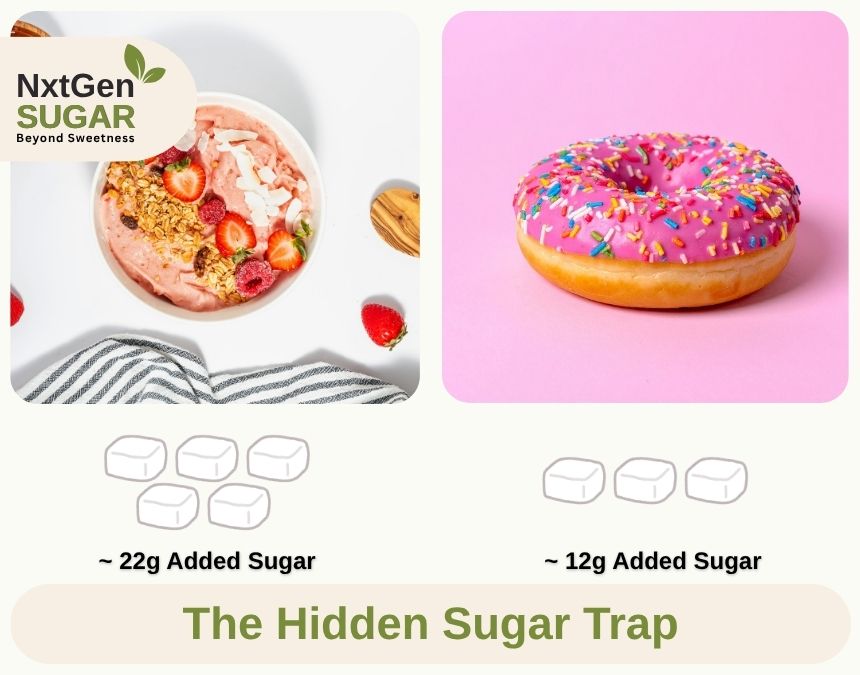
Hidden Sugars in Everyday Foods: Why Your “Healthy” Diet Might Be Sabotaging You (Episode 1)
Most people operate under a very simple, yet fundamentally flawed, assumption: You only consume sugar when you eat sweets. If you avoid donuts in the breakroom, skip the ice cream after dinner, and pass on the candy aisle at the grocery store, you are likely patting yourself on the back for living a low-sugar lifestyle.
But what if the bulk of your daily sugar intake is coming from foods that don’t even taste like dessert?
The real crisis in modern nutrition is not the sugar we see. It is the hidden sugars in everyday foods.
Welcome to Episode 1 of Hidden Sugar, a new series by NxtGenSugar. In this series, we are pulling back the curtain on the food industry. We will explore how modern dietary habits are changing, how manufacturers formulate packaged goods, and why consumer awareness matters now more than ever before.
The future of food is shifting. Let’s expose the hidden sugars lurking in your pantry, and explore how the next generation of food entrepreneurs is building a more transparent future.
The Illusion of Healthy Eating: How Hidden Sugars in Everyday Foods Became the Norm
To understand how sugar ended up in everything from your morning toast to your evening salad, we have to look back at the food manufacturing boom of the late 20th century.
When the diet industry declared war on dietary fat in the 1980s and 1990s, food manufacturers scrambled to create “low-fat” and “fat-free” versions of everyday products. But there was a massive problem: when you strip the fat out of food, you remove the flavor, the mouthfeel, and the satisfying texture. The food tastes like cardboard.
To make these fat-free foods palatable again, the consumer packaged goods (CPG) industry turned to the cheapest, most effective flavor-enhancer and bulking agent available: refined sugar.
Decades later, the low-fat craze has subsided, but the sugar remains. The modern palate has been systematically conditioned to expect a baseline level of sweetness in almost everything we eat. Today, roughly 74% of all packaged foods sold in supermarkets contain added sweeteners. It is not an accident; it is a calculated formulation strategy.
The “Healthy” Traps: Where Hidden Sugar Lurks in Plain Sight
When we think of a high-sugar diet, we picture soda and pastries. But the most insidious sources of added sugar wear a “health halo.” These are products marketed with words like natural, organic, whole-grain, and light.
If you want to optimize your metabolic health or formulate cleaner products, you must recognize the four biggest offenders quietly adding sweetness to the modern diet.
1. The Flavored Yogurt Illusion
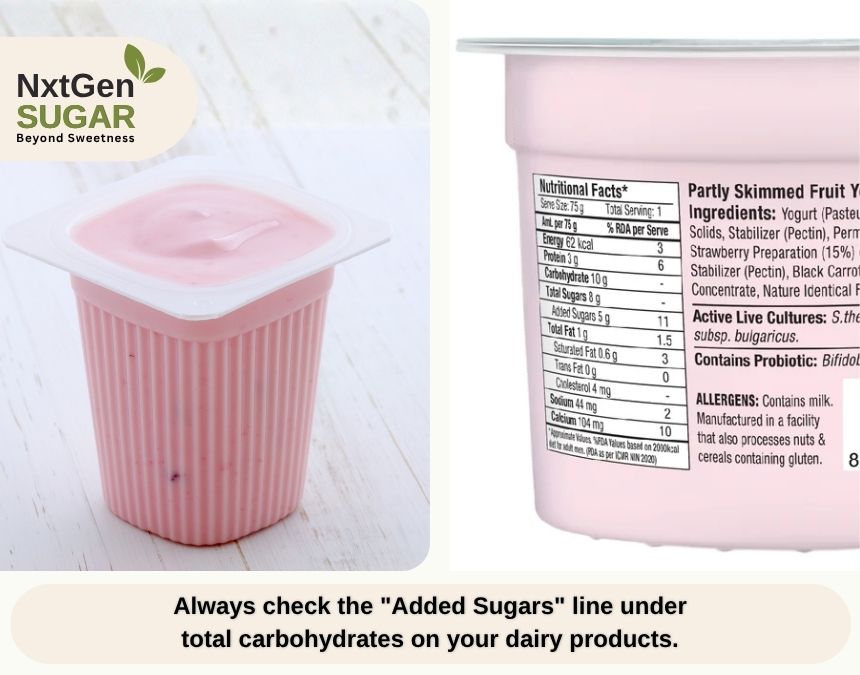
Yogurt has enjoyed a reputation as a quintessential health food for decades. It is rich in calcium, packed with protein, and full of gut-friendly probiotics. However, the vast majority of yogurt consumed today is heavily flavored and sweetened.
A standard serving of plain, unsweetened Greek yogurt contains about 4 to 6 grams of naturally occurring milk sugar (lactose), which is perfectly healthy. But pick up a “Strawberry” or “Vanilla Bean” yogurt off the shelf, and you might find up to 20 to 25 grams of sugar per serving.
To put that in perspective, a standard glazed donut contains about 10 grams of sugar. That “healthy” morning yogurt can easily contain twice the sugar of a bakery dessert. The probiotics might be real, but they are swimming in a syrup of refined carbohydrates.
2. The Breakfast Cereal Deception
Breakfast is arguably the most heavily marketed meal of the day, and cereals are at the center of the deception. Manufacturers know that consumers are looking for heart-healthy options. Therefore, they plaster boxes with claims like “Made with Whole Grains,” “Excellent Source of Fiber,” or “Fortified with Vitamins.”
But if you turn the box around, the reality is stark. Many cereals marketed directly to health-conscious adults (like granola clusters, bran flakes with raisins, or honey-nut varieties) contain 12 to 18 grams of added sugar per relatively small cup.
Worse yet, consumers rarely eat the recommended serving size. By the time you fill a standard cereal bowl, you could be consuming 30 grams of hidden sugar before you even leave for work. This sets off an insulin spike that guarantees a mid-morning energy crash.
3. The Savory Saboteurs: Sauces, Dressings, and Ketchup
This is where the hidden sugar crisis becomes truly deceptive. We expect sugar in sweet things, but we do not expect it in savory items.
Take ketchup, for example. Tomatoes are naturally acidic. To balance that acidity and create a universally appealing flavor profile, manufacturers pump ketchup full of high-fructose corn syrup. A single tablespoon of standard ketchup contains about 4 grams of sugar. If you generously dip your fries, you are easily consuming the sugar equivalent of a handful of candy.
Pasta sauces and marinara are just as guilty. A half-cup serving of leading commercial pasta sauce can contain 10 to 12 grams of added sugar. Salad dressings—especially “low-fat” raspberry vinaigrettes, honey mustards, and sweet onion dressings—are essentially flavored syrups poured over healthy greens, completely negating the metabolic benefits of the salad.
4. The Liquid Sabotage: Packaged Drinks and “Teas”
Soda sales have been declining for years as consumers wise up to the dangers of liquid sugar. But the beverage industry simply pivoted. They introduced “enhanced waters,” bottled iced teas, sports drinks, and fruit juices that masquerade as wellness beverages.
A bottle of green tea sounds like a fantastic choice—until you realize the manufacturer added 35 grams of cane sugar to it. “100% fruit juice” is often just as metabolically damaging as soda. Even without added sugars, the juicing process strips away the natural fiber of the fruit, leaving a concentrated blast of fructose that overloads the liver.
The Alias Game: How to Spot Hidden Sugars in Everyday Foods on the Label
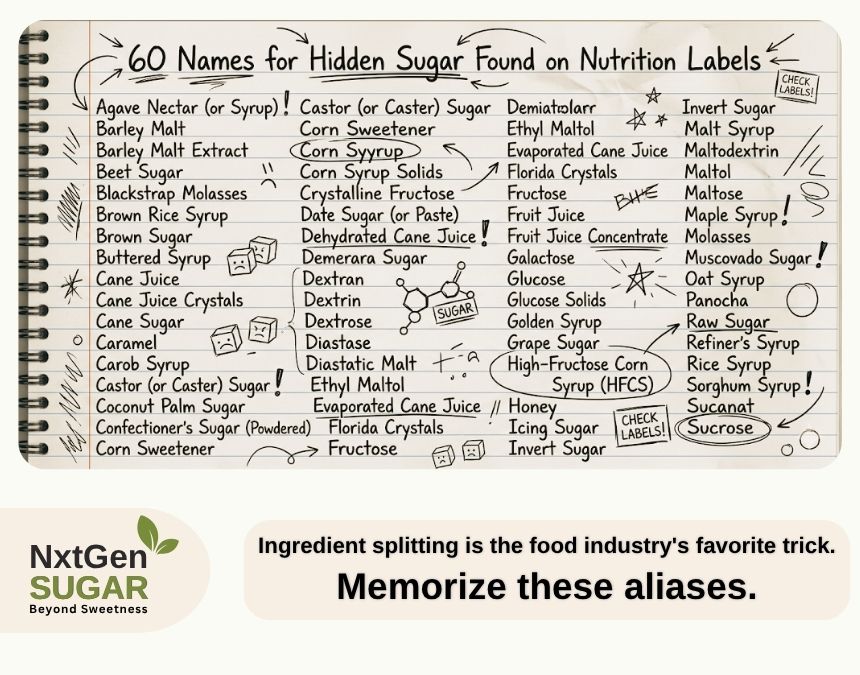
Why do consumers keep falling for these traps? Because the food industry is exceptionally good at hiding sugar behind complex terminology.
The next generation of consumers is reading labels more carefully than ever before. But to truly understand what you are putting in your body, you have to speak the industry’s language.
By law, ingredients on a nutrition label must be listed in descending order of weight. If sugar is the first or second ingredient, you know the product is loaded with it. To get around this, manufacturers use a trick called ingredient splitting.
Instead of using 15 grams of normal cane sugar (which would put sugar at the top of the list), they will use 5 grams of maltodextrin, 5 grams of oat syrup, and 5 grams of fruit juice concentrate. They are all sugar, but by splitting them up, they get pushed further down the ingredient list, making the product appear healthier.
Common Aliases for Added Sweeteners
There are currently over 60 different names for sugar used on food labels. If you want to take back control of your diet, watch out for these hidden aliases:
-
The “Ose” Family: Dextrose, fructose, glucose, lactose, maltose, sucrose. (If it ends in “ose,” it is sugar).
-
The Syrups: High-fructose corn syrup, brown rice syrup, maple syrup, agave nectar, malt syrup, oat syrup.
-
The “Natural” Disguises: Coconut sugar, date sugar, organic raw cane juice, evaporated cane juice, fruit juice concentrate.
-
The Extracts and Malts: Barley malt, molasses, maltodextrin, diastatic malt.
(Note: Your liver processes “natural” disguises almost identically to standard white table sugar).
The Consumer Shift: From Taste to Transparency in Food Tech
For decades, the food industry operated on a single, guiding principle: create the most hyper-palatable, highly addictive flavor profile possible, as cheaply as possible.
But a massive paradigm shift is happening. We are witnessing the rise of the educated consumer.
Driven by access to information, the proliferation of wellness podcasts, and the widespread use of continuous glucose monitors (CGMs), the public is waking up. They are realizing that chronic fatigue, brain fog, and stubborn weight gain are not personal failures. They are the direct biological result of a food supply that is secretly saturated with refined carbohydrates.
The next generation doesn’t just want lip service. They don’t want a “Low Sugar” sticker slapped on a box of highly processed, synthetic chemicals. They want total transparency.
The future of food is not just about chasing:
-
More sweetness at any cost
-
Artificial zero-calorie chemical replacements
-
Clever marketing loopholes
The NxtGenSugar Philosophy: Smarter Sugar for the Future
The “Hidden Sugar” epidemic is exactly why we are building something new.
At NxtGenSugar, we believe that food entrepreneurs and CPG brands have a profound responsibility to the consumer. We cannot continue to treat sugar as a cheap filler. We must treat it as a powerful, functional ingredient that requires deep scientific respect.
The future of food belongs to brands that deliver:
-
Smarter ingredients: Utilizing functional, fiber-rich alternatives that respect the body’s glycemic response.
-
Better awareness: Educating the consumer rather than deceiving them with ingredient-splitting and misleading packaging.
-
Balanced choices: Formulating products that deliver incredible sensory experiences without compromising metabolic health.
When a modern, health-conscious consumer picks up a product, the calculation has changed. “Is it tasty?” is no longer the final question. The final question is, “What is really inside it, and how is it going to make me feel an hour from now?”
Taking Control of Hidden Sugars in Everyday Foods
Better food isn’t created by hiding ingredients; it is created by mastering them. It is about understanding the functional chemistry of sweetness, the biological reality of metabolism, and the moral imperative of clean labels.
You deserve to know what you are eating. You deserve food that fuels you, not food that secretly works against you. The era of deception is coming to an end. The era of Smarter Sugar is here.
This is just the beginning of the conversation. In Episode 2, we will dive deeper into the chemistry of alternative sweeteners, exploring what actually works and what causes massive digestive distress. Start auditing your pantry today, and take the first step toward eliminating hidden sugars in everyday foods.