Modern Sugar Consumption Habits: How the Food Industry Trains You to Crave (Episode 3)
Nobody wakes up on their very first day of life craving refined sugar. They are trained to.
Welcome to Episode 3 of the Hidden Sugar Series by NxtGenSugar. In Episode 1, we uncovered the hidden sugars in our pantries. In Episode 2, we explored the neuroscience of hyper-palatability. Today, we are analyzing the behavioral architecture of the consumer.
The real danger of the modern food environment isn’t the occasional decadent dessert. The true danger is repetition. It is the insidious, creeping normalization of sweetness in everything we consume.
When you examine modern sugar consumption habits, you realize that sweetness is no longer an active choice. It is a programmed lifestyle. Day by day, through perfectly engineered product placements and routine-based marketing, the food industry quietly reshapes our biological taste expectations.
Today, many people don’t even realize how often they consume sweetness because it no longer feels “special.” It feels normal. And that changes everything for the future of food.
The Architecture of a Hidden Sugar Lifestyle
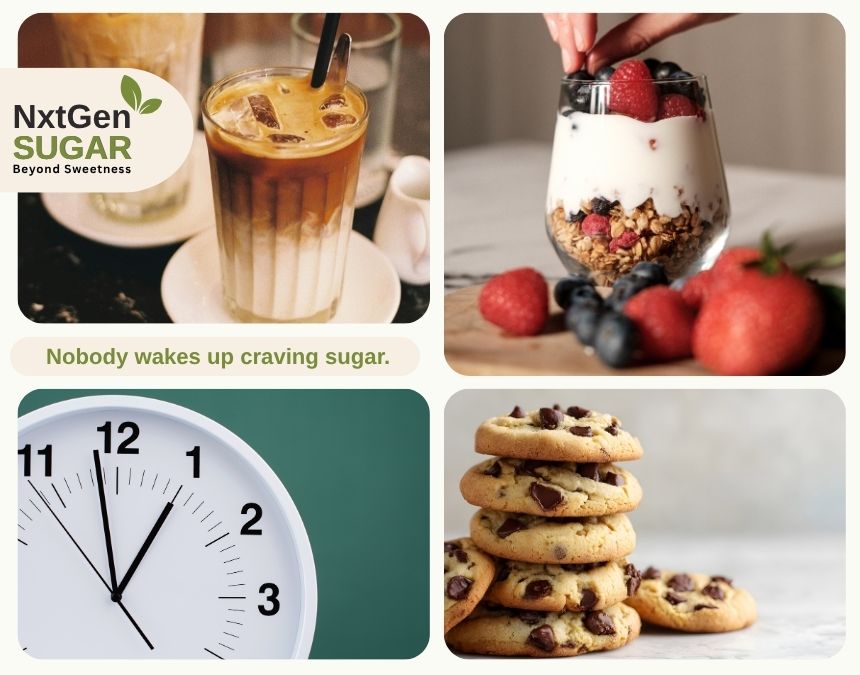
To understand how modern sugar consumption habits are formed, we have to look at the anatomy of a typical day. The consumer packaged goods (CPG) industry has masterfully mapped out the human circadian rhythm. They have formulated a specific, sugar-loaded product for every single physiological dip in your day.
This is not accidental. It is a highly optimized business model designed to create a continuous sugar habit loop. Let’s break down the daily cycle of engineered dependency.
The Morning Primer: Establishing the Baseline
The training begins the moment you wake up. You might think you are just getting caffeine, but that “standard” vanilla latte or caramel macchiato often contains upwards of 30 to 40 grams of liquid sugar.
If you pair that with a flavored yogurt or a “healthy” granola bar, you have consumed more than your daily recommended limit of added sugar before 9:00 AM. This morning primer sets your blood glucose on a massive upward trajectory, guaranteeing a sharp insulin response and a subsequent mid-morning crash.
The Afternoon Slump: The “Energy Booster” Trap
By 2:00 PM, the morning glucose spike has crashed. Your brain, feeling starved for energy, triggers a biological alarm. The food industry anticipates this perfectly.
This is when consumers reach for flavored iced teas, sports drinks, or protein bars. These products are heavily marketed as “energy boosters” or “focus enhancers.” In reality, they are just secondary sugar delivery systems. They provide a rapid spike of fructose and glucose to artificially lift you out of the afternoon slump that the morning sugar created.
The Late-Night Reward: Stress and Serotonin
Finally, the day ends. The stress of modern work and life takes its toll. In the evening, the brain seeks comfort and dopamine.
Late-night cravings are the final stage of the daily sugar cycle. Whether it is a bowl of sweetened cereal, a few cookies, or a seemingly innocent piece of dark chocolate, this final hit of sweetness acts as a neurochemical soothing agent.
When this cycle repeats daily for years, sweetness stops becoming a dietary choice. It becomes the structural scaffolding of your daily routine.
How Repetition Reshapes Biological Taste Expectations
Why does this repetition matter so much? Because human biology is highly adaptive.
When you subject your palate to constant, unrelenting sweetness, your body undergoes sensory adaptation. This is the physiological core of modern sugar consumption habits. You are literally numbing your own taste receptors.
The Normalization of Extreme Sweetness
Decades ago, sweetness was rare. It was found in seasonal fruits or occasional baked goods. Because it was rare, human tastebuds were highly sensitive to it. A simple ripe strawberry tasted profoundly sweet.
Today, because of the hidden sugars injected into our sauces, breads, and beverages, our baseline expectation for sweetness has skyrocketed. If you eat ultra-processed foods every day, a strawberry no longer registers as sweet. To get the same dopamine response, you need highly concentrated, refined syrups.
Many consumers genuinely believe they just have a “sweet tooth.” They do not realize that their palate has been systematically desensitized by the products they buy.
The Erosion of the “Special Treat”
Because extreme sweetness has become the baseline, the concept of a “special treat” has been entirely eroded.
When your morning coffee tastes like a milkshake, your afternoon protein bar tastes like a candy bar, and your salad dressing tastes like syrup, what is left for dessert?
When everything is sweet, nothing is special. We are consuming dessert-level sugar volumes around the clock, masquerading as functional meals. This constant exposure keeps the body in a state of chronic inflammation and insulin resistance, driving the modern metabolic health crisis.
The Behavioral Psychology of the Sugar Habit Loop
To truly disrupt modern sugar consumption habits, food innovators must understand the psychology of habits. In behavioral science, a habit consists of three components: the Cue, the Routine, and the Reward.
The legacy food industry exploits this loop flawlessly.
-
The Cue: You feel stressed, tired, or simply experience a specific time of day (e.g., the 3:00 PM slump).
-
The Routine: You consume a hyper-palatable, sweetened beverage or snack.
-
The Reward: You receive an instant, mathematically optimized hit of dopamine and a rapid spike in blood glucose.
Over time, the brain wires the Cue directly to the Reward. You no longer even think about the Routine. You simply feel stressed, and your hand automatically reaches for the sweetened product.
This is why traditional diet advice fails. You cannot simply tell a consumer to “eat less sugar” when their entire behavioral framework and neurochemistry have been trained to depend on it. We do not need more willpower; we need better food formulation.
The Future Divide: CPG Products Built on Cravings vs. Awareness
The food industry is currently standing at a massive crossroads. The next generation of consumers is waking up. They are tracking their glucose, reading labels, and realizing that their daily habits have been engineered against them.
Moving forward, the food industry will no longer be divided simply between “sugar” and “sugar-free.” That is an outdated metric.
The industry will be divided by intent.
The Old Model: Products Designed to Increase Cravings
Legacy brands will continue to rely on the old model. They will utilize ingredient splitting, hidden aliases for sugar, and artificial high-intensity sweeteners to hit the “Bliss Point.”
Their ultimate goal is dependency. They want to ensure that their products fit perfectly into your daily habit loop, keeping your palate desensitized and your cravings high. They view the consumer as a biological algorithm to be exploited for repeat purchases.
The New Model: Products Designed with Awareness
The future belongs to the innovators. The next generation of food entrepreneurs is building clean label CPG products designed with absolute awareness.
These brands understand that food should nourish, not manipulate. They are asking the hard questions: How do we formulate a product that tastes incredible but respects the consumer’s glycemic response? How do we use functional ingredients to provide sustained energy, rather than a cheap dopamine spike?
Brands built on awareness prioritize transparency. They aim to reset the consumer’s baseline, helping them break free from the cycle of chronic sweetness so they can experience the true flavors of real food again.
The NxtGenSugar Solution: Breaking the Cycle
At NxtGenSugar, we recognize that breaking these ingrained modern sugar consumption habits requires a fundamental shift in how we manufacture food.
We cannot expect the consumer to change if the environment does not change. That is why our mission goes beyond simply supplying alternative ingredients. We are fundamentally rethinking the formulation matrix.
By leveraging advanced, fiber-rich alternatives and Smarter Sugar strategies, we help CPG brands create products that satisfy without triggering the addictive habit loop. We are moving the industry away from manipulation and toward intelligent, metabolic-friendly innovation.
We are not just reducing sugar. We are restoring the consumer’s right to choose.
TLDR: The Generational Stakes
Your daily habits are not entirely your fault, but taking control of them is your responsibility. Once you see the hidden sugar lifestyle for what it is—a programmed loop of cues and cravings—you can begin to step outside of it.
Start by auditing your morning routine. Look at the labels on your “energy boosters.” Reclaim your palate by choosing products designed with awareness, not addiction.
But what happens when this programming starts before a consumer can even read a label?
Episode 4 gets to the heart of the crisis: “Why children today may never experience natural sweetness the way previous generations did.” The conversation is shifting. The future of food is transparent. Are you ready to rethink your habits?