Childhood Taste Expectations: How the Food Industry Hijacked the Next Generation (Episode 4)
Imagine a very simple scenario. A child from 1990 and a child from 2026 walk into a fruit shop. The shopkeeper offers them both a perfectly ripe, seasonal mango.
The first child smiles, viewing the fruit as a profoundly sweet, rare treat.
The second child takes a bite, looks at the shopkeeper, and asks, “Do you have something more exciting?”
Welcome to Episode 4 of the Hidden Sugar Series by NxtGenSugar.
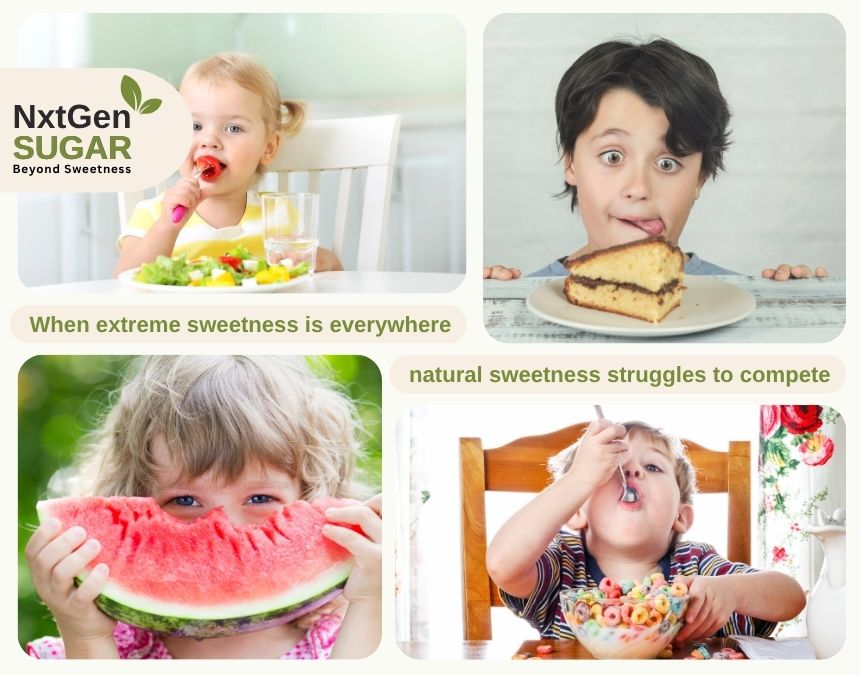
This scenario is not a judgment on modern parenting, nor does it mean that today’s children are inherently different. It happens because their taste buds are growing up in a completely different, highly engineered ecosystem. They are being raised in an environment saturated with ultra-sweet snacks, flavored drinks, and chocolate spreads.
When artificial sweetness is everywhere, natural sweetness is forced to compete on an unfair playing field.
This is the hidden shift that nobody in the food tech industry wants to talk about. The primary question for consumer packaged goods (CPG) brands isn’t simply, “Are kids eating too much sugar?” The real, foundational question is: What will the next generation consider normal?
Let’s explore how the food industry is aggressively altering childhood taste expectations, and why the future of food depends on making real food exciting again.
The Evolutionary Biology of the Child’s Palate
To understand why the modern food environment is so devastating to childhood taste expectations, we must first look at evolutionary biology.
Children are not just miniature adults when it comes to flavor perception. A child possesses significantly more taste buds than an average adult, and those taste receptors are highly sensitive. From an evolutionary standpoint, this biological design served a critical purpose for human survival.
Historically, sweetness signaled two things to a growing child:
-
The food was safe (not poisonous or toxic, which usually presents as bitter).
-
The food was highly caloric and energy-dense, which was vital for fueling rapid physical growth and brain development.
Because of this, children are biologically hardwired to prefer sweet flavors over bitter or sour ones. For thousands of years, this evolutionary trait protected them. When the sweetest thing in the environment was a piece of fruit or a drop of honey, a child’s natural preference for sweetness was perfectly balanced with nutritional intake.
The Hijacking of Childhood Taste Expectations
The crisis we face today occurs because the legacy food industry discovered this evolutionary biological vulnerability and weaponized it for profit.
By the late 1990s and early 2000s, CPG manufacturers realized that if they maximized the sugar content in cereals, yogurts, and snacks, they could guarantee brand loyalty from the youngest demographic possible. They began engineering products that bypassed a child’s natural satiety signals.
Today, childhood taste expectations are being shaped by a world of:
-
Candies and Confections: Marketed not as occasional treats, but as everyday rewards.
-
Flavored Drinks: Fruit juices and sports drinks that contain the exact same sugar profiles as carbonated sodas.
-
Chocolate Spreads and Syrups: Positioned as standard breakfast staples to be smeared on toast or pancakes every morning.
-
Ultra-Sweet Snacks: Granola bars and fruit snacks that are essentially candy masquerading as health food.
When a child’s palate is bombarded with concentrated, refined sugars from the moment they wake up until they go to sleep, a radical sensory shift occurs.
The Escalation of the “Normal” Baseline
When sweetness is everywhere, natural sweetness has to compete. And unfortunately, in a direct chemical comparison, nature loses.
A ripe mango contains a complex matrix of fructose, water, and dietary fiber. It is naturally delicious. However, it cannot chemically compete with a fluorescent, high-fructose corn syrup-infused fruit snack that has been engineered in a laboratory to hit the exact “Bliss Point” of a child’s dopamine receptors.
Because modern children are exposed to these hyper-palatable foods daily, their baseline for what constitutes “sweet” has been artificially raised. This is how childhood taste expectations become distorted. Real, whole foods suddenly taste bland, boring, and unexciting.
The Generational Ripple Effect of Food Habits
Why does this desensitization matter to the future of the food industry? Because today’s taste expectations become tomorrow’s food habits. And those food habits become lifelong, deeply ingrained choices.
We are currently raising a generation of consumers whose baseline sensory requirements are fundamentally incompatible with real, agricultural food.
From Picky Eaters to Metabolic Dysfunction
When a child rejects a piece of fruit or a vegetable because it isn’t “exciting” enough, parents often label them as “picky eaters.” But in reality, the child is suffering from sensory adaptation.
This early exposure to extreme sweetness sets the stage for a lifetime of metabolic dysfunction. When a child relies on highly refined carbohydrates and sugars for every meal, their developing body is subjected to a constant rollercoaster of insulin spikes and crashes.
This is why we are seeing unprecedented rates of childhood insulin resistance, early-onset metabolic syndrome, and pediatric obesity. The legacy food industry is not just selling snacks; they are actively programming the metabolic destiny of the next generation.
Formulating for the Next Generation: The CPG Dilemma
For food entrepreneurs, founders, and R&D professionals, this presents a massive ethical and commercial dilemma.
How do you formulate products for a demographic whose childhood taste expectations have already been hijacked by legacy brands? If you create a clean-label, low-sugar product for kids, they might reject it because it doesn’t match the extreme sweetness of your competitors.
But if you simply match the competitor’s sugar profile, you become part of the problem. You contribute to the escalating cycle of the bliss point.
The Era of “Smarter Sugar” in Kids’ Nutrition
The answer is not simply creating sweeter products using artificial, zero-calorie chemicals. Children’s bodies are highly sensitive, and exposing them to synthetic sweeteners or highly processed sugar alcohols can disrupt their developing gut microbiomes.
The answer is structural innovation. The future food industry will be divided by intent. The brands that win the trust of modern, educated parents will be the ones that understand how to formulate intelligently.
We must shift the focus from “maximum sweetness” to functional formulation. This means:
-
Utilizing whole-food sweetness from actual fruit matrices.
-
Incorporating functional prebiotic fibers to slow the glycemic response and protect the child’s metabolic health.
-
Rebalancing the flavor profile so that children can experience the nuances of natural ingredients, rather than just a monolithic wall of sugar.
The NxtGenSugar Vision: Making Real Food Exciting Again
At NxtGenSugar, we believe the era of exploiting a child’s biological preference for sugar is over.
The next generation of parents is reading labels, questioning ingredients, and desperately searching for brands they can trust. They do not want to feed their children hyper-palatable science experiments. They want honest, clean-label CPG products.
Our mission is to help food manufacturers pivot. We are developing the ingredient technologies and the formulation strategies necessary to reset childhood taste expectations.
Maybe the future of food isn’t about figuring out how to create a sweeter product. Maybe it is about taking the structural functionality of sugar and using it to make real food exciting again. We can engineer textures, mouthfeels, and flavor releases that delight children without compromising their biological future.
Conclusion: Preparing for the Next Era of Transparency
We have a profound responsibility to the next generation. The food they consume today builds the cellular architecture of their bodies tomorrow.
By choosing to formulate with Smarter Sugar, we can slowly lower the artificially high baseline of sweetness that has plagued the modern diet. We can ensure that when a child in the future is handed a piece of fresh fruit, they experience the pure, unadulterated joy of natural sweetness.
But the legacy industry will not go down without a fight. They have spent decades perfecting the art of deception on their nutrition labels.
Join us in Episode 5: Can you spot sugar when it hides behind 20 different names on a label? We will expose the exact terminology used to trick parents and health-conscious consumers. The future of food is transparent. Let’s build it together.