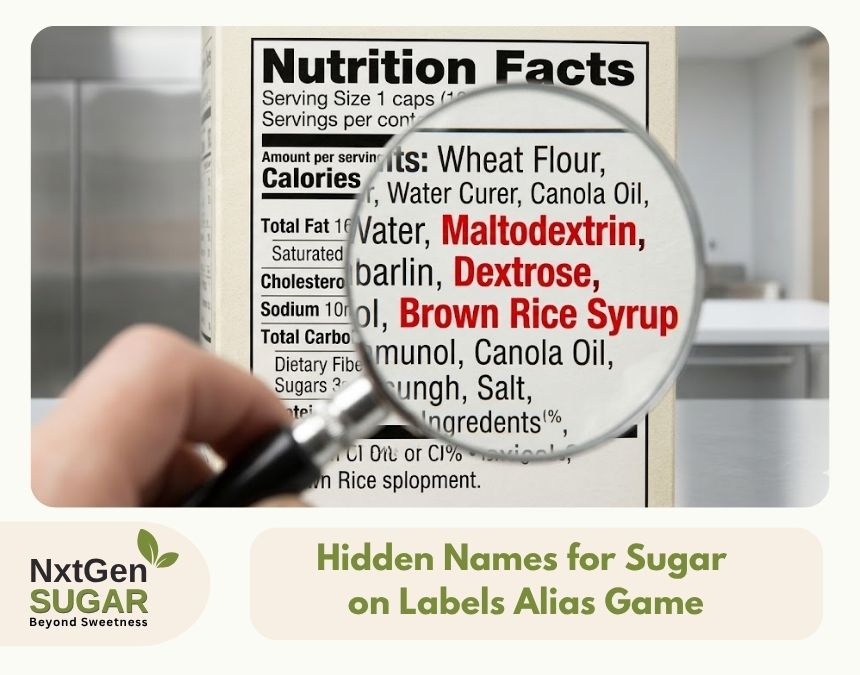
Hidden Names for Sugar on Labels (Episode 5)
You stand in the grocery store aisle, holding a box of “healthy” granola bars. You turn the box around and scan the ingredient list. You don’t see the word “sugar” anywhere near the top. Satisfied, you drop the box into your cart, confident that you have made a metabolically responsible choice for your family.
Welcome to Episode 5 of the Hidden Sugar Series by NxtGenSugar.
What you experienced in that grocery aisle was not an informed choice. It was a perfectly executed illusion.
The manufacturer did not remove the sugar from that granola bar. They simply changed the language they used to describe it. In the modern consumer packaged goods (CPG) industry, transparency is often treated as a liability rather than a baseline. To maintain the hyper-palatability of their products without alarming health-conscious consumers, food brands have developed an intricate system of camouflage.
Currently, there are over 60 different legal aliases for sugar used in food manufacturing. If you want to protect your metabolic health—or if you are a food founder looking to build a brand built on actual trust—you must understand how to spot the hidden names for sugar on labels.
Let’s decode the alias game, expose the loopholes, and explore why the future of food depends on radical transparency.
The Illusion of Transparency: The “Ingredient Splitting” Loophole
To understand why a food label can be inherently deceptive, you have to understand the regulatory framework that governs it. In most developed nations, regulatory bodies (like the FDA) mandate a very specific rule for ingredient lists: Ingredients must be listed in descending order of predominance by weight.
This means that the heaviest ingredient must be listed first, and the lightest ingredient is listed last.
For a health-conscious consumer, this rule seems incredibly helpful. If “sugar” is the first or second ingredient, the consumer instantly knows the product is basically dessert and puts it back on the shelf.
How Manufacturers Game the System
Legacy food manufacturers know exactly how consumers read labels. To prevent sugar from appearing at the top of the list, food scientists utilize a deceptive, yet perfectly legal, formulation tactic called Ingredient Splitting.
Here is how the math works: Imagine a CPG brand is formulating a protein bar. To make it taste good and bind together, the recipe requires 15 grams of added sweetener. If they use 15 grams of standard cane sugar, sugar becomes the heaviest ingredient and must be listed first.
Instead, the formulation team splits the sweetener into three different components:
-
5 grams of Maltodextrin
-
5 grams of Brown Rice Syrup
-
5 grams of Dextrose
By fracturing the sweetener into three distinct, smaller parts, the total weight of each individual sweetener is drastically reduced. Now, protein and oats can take the number one and two spots on the ingredient list. The three sugars are banished to the bottom of the paragraph, hidden among the vitamins and preservatives.
The label looks infinitely cleaner. The consumer feels safe. But the biological reality remains exactly the same: the consumer is still eating 15 grams of refined carbohydrates.
Decoding the Dictionary: Top Hidden Names for Sugar on Labels
To navigate the modern food supply, consumers must become fluent in the industry’s chemical vocabulary. You cannot rely on a “Low Sugar” sticker on the front of the packaging; you must audit the back.
Here is the definitive guide to spotting the most common hidden names for sugar on labels.
1. The “Ose” Family (Chemical Sugars)
In biochemistry, the suffix “-ose” denotes a sugar molecule. When manufacturers isolate specific sugars in a laboratory setting, they use their chemical names on the label. This makes the ingredient list sound highly scientific and less like a dessert. If an ingredient ends in “-ose,” it is an added sugar.
-
Dextrose: A highly refined sugar derived from corn. It is chemically identical to glucose and spikes blood sugar instantly.
-
Fructose: Naturally found in fruit, but when extracted and added as a standalone ingredient, it goes straight to the liver and drives insulin resistance.
-
Maltose: A sugar produced by the breakdown of starch, often used in bread and cereals to accelerate browning.
-
Sucrose: The chemical name for standard white table sugar.
2. The “Natural” Disguises (Health Halo Sugars)
This is the most insidious category. Brands know that consumers are terrified of high-fructose corn syrup, so they replace it with sweeteners that sound natural, agricultural, and wholesome. However, your pancreas cannot read marketing copy. It processes these “natural” sweeteners almost identically to refined white sugar.
-
Fruit Juice Concentrate: The food industry strips away the fiber, water, and vitamins from a fruit, leaving behind a highly concentrated syrup of pure fructose. It is sugar, hiding behind the halo of a fruit.
-
Agave Nectar: Heavily marketed as a low-glycemic health food in the 2010s, agave is actually up to 90% liquid fructose, making it incredibly taxing on the human liver.
-
Evaporated Cane Juice: This is literally just standard sugar, but using the words “evaporated” and “juice” makes consumers feel like they are buying a minimally processed botanical.
-
Coconut Sugar & Date Sugar: While they do contain trace amounts of minerals, they are still dense, caloric sugars that trigger a significant glycemic response.
3. The Syrups and Malts (The Binding Agents)
In baked goods, granola bars, and sauces, sugar isn’t just used for flavor—it is used for viscosity and texture. Manufacturers use heavy, sticky syrups that consumers rarely recognize as pure sugar.
-
Maltodextrin: A highly processed white powder made from corn, rice, or potato starch. It is used as a thickener and filler. Astonishingly, maltodextrin has a higher Glycemic Index than pure table sugar, meaning it spikes your blood glucose faster than eating candy.
-
Brown Rice Syrup: Sounds healthy because it contains the word “brown rice,” but it is essentially pure glucose.
-
Barley Malt & Diastatic Malt: Commonly used in the bakery sector to feed yeast and provide a deep, caramel color to breads and bagels.
The Biological Cost of Consumer Confusion
Why does this alias game matter so deeply? Because consumer confusion has a direct, devastating impact on global metabolic health.
When people consume hidden names for sugar on labels without realizing it, they lose the ability to accurately track their dietary intake. A mother might strictly limit her child’s candy consumption, entirely unaware that the child is consuming the exact same volume of sugar through their “healthy” organic ketchup, fortified breakfast cereal, and fruit-infused water.
This leads to a psychological phenomenon known as the Placebo Effect of Healthy Buying. Consumers pay a premium price for products marketed as “clean” and “natural,” fully believing they are optimizing their health. When they continue to struggle with chronic fatigue, stubborn weight gain, and pre-diabetes, they blame themselves. They assume their biology is failing them, not realizing that the food industry has been actively deceiving them.
We cannot solve the metabolic health crisis until we fix the transparency crisis.
Formulating for Trust: The Clean Label Mandate
For decades, the standard operating procedure in the CPG industry was simple: Hide the sugar, protect the flavor, and maximize the profit.
But the landscape is rapidly shifting. We are entering the era of the hyper-educated consumer. Empowered by continuous glucose monitors (CGMs), health podcasts, and an abundance of nutritional data, the modern consumer is learning to see through the alias game.
If you are a founder, food scientist, or CPG executive, the old playbook will no longer work. Brands that continue to rely on ingredient splitting and deceptive nomenclature will be exposed and abandoned by the next generation.
The future of the food industry belongs to brands that view transparency not as a regulatory burden, but as their primary competitive advantage. The mandate is clear: We must formulate for trust.
The NxtGenSugar Philosophy: Radical Transparency
At NxtGenSugar, we believe the era of tricking the consumer must come to a definitive end. Better food is not built on regulatory loopholes; it is built on scientific innovation and honest formulation.
We are championing the transition to Smarter Sugar.
Smarter Sugar means abandoning the alias game. It means looking at the functional chemistry of food and finding ways to provide bulk, texture, and flavor without hiding behind a paragraph of 60 different chemical names. By leveraging advanced prebiotic fibers, functional natural sweeteners, and deep R&D, we help CPG brands build labels that they are proud to show the world.
If your product relies on hiding its ingredients to sell, you do not have a sustainable product. You have a marketing gimmick.
Conclusion: Take Back Your Pantry
The next time you go to the grocery store, do not look at the front of the box. The front of the box is marketing. The back of the box is the biological reality.
Audit your pantry. Look for the “-ose” family. Look for the syrups. Look past the “natural” fruit concentrates. Once you learn to spot the hidden names for sugar on labels, you take the power away from the manufacturer and put it back in your own hands.
We have explored the aliases, the psychology, and the habits of modern food consumption. But there is one final, critical piece of the puzzle. What happens to your body when the food industry decides to remove the sugar completely, but replaces it with something artificial?
Join us for Episode 6: The “Zero Sugar” Illusion: Why Artificial Sweeteners are Sabotaging Your Gut Health.
The conversation is just getting started. It is time to rethink your formula.