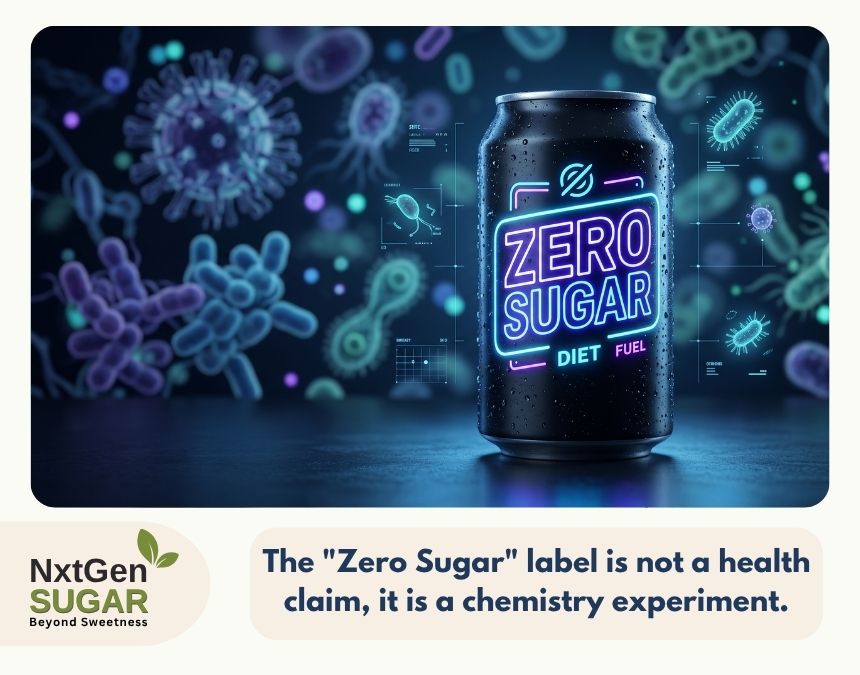
The “Zero Sugar” Illusion: Why Artificial Sweeteners and Gut Health Are on a Collision Course (Episode 6)
For the past twenty years, the global food industry has been selling consumers a metabolic miracle. The promise was simple, alluring, and heavily marketed: You can eat all the sweet, hyper-palatable foods you want, without any of the caloric consequences.
Welcome to Episode 6 of the Hidden Sugar Series by NxtGenSugar. In Episode 5, we exposed how legacy brands hide real sugar behind 60 different aliases. Today, we must address an even more dangerous formulation tactic. What happens when the manufacturer actually removes the sugar, but replaces it with something entirely synthetic?
We have entered the era of the “Zero Sugar” illusion.
Driven by consumer demand and government pressure to reduce obesity, consumer packaged goods (CPG) brands scrambled to eliminate carbohydrates. But they did not do this by making real, whole foods more exciting. They did it by swapping agricultural ingredients for synthetic chemicals.
Now, a massive biological bill is coming due. The scientific community is raising a massive red flag regarding artificial sweeteners and gut health. Let us explore why tricking your tongue is wreaking havoc on your microbiome, and why the future of food formulation must abandon the artificial “Zero.”
The Rise of the “Zero Sugar” Illusion
To understand the current crisis, we have to look at the formulation playbook of the legacy diet industry. When you remove sugar from a beverage, a protein bar, or a baked good, you lose both sweetness and physical bulk.
To replace the sweetness, food scientists turned to high-intensity artificial sweeteners. These are chemicals synthesized in a laboratory that are hundreds, sometimes thousands, of times sweeter than standard sucrose.
Because they are so intensely sweet, manufacturers only need to use microscopic amounts to hit the consumer’s “Bliss Point.” Since the volume is so low, they contribute zero functional calories to the diet.
On paper, this looks like a triumph of food tech. The nutrition label looks incredibly clean. Zero sugar, zero calories, zero guilt.
However, human biology does not operate on a simple “calories in, calories out” spreadsheet. The human digestive tract is a complex, living ecosystem. When you ingest a synthetic chemical that your evolutionary biology has never encountered, the body does not simply ignore it. It reacts.
The Microbiome Crisis: Artificial Sweeteners and Gut Health
The most significant casualty of the “Zero Sugar” movement is the human microbiome. Your gut microbiome is a vast ecosystem of trillions of bacteria, viruses, and fungi residing in your digestive tract.
These microbes are not just passengers; they are the control center of your immune system, your neurotransmitter production, and your metabolic function. A healthy, diverse microbiome protects against inflammation and regulates how your body extracts energy from food.
The link between artificial sweeteners and gut health is becoming one of the most heavily researched topics in modern gastroenterology.
How Sucralose and Aspartame Alter Your Bacteria
For decades, the FDA and food manufacturers claimed that artificial sweeteners like Sucralose and Aspartame passed through the human body completely unabsorbed and inert. We now know this is categorically false.
Recent clinical studies have demonstrated that these high-intensity sweeteners actively interact with gut bacteria. When exposed to sucralose, beneficial bacterial strains (like Bifidobacteria and Lactobacilli) are suppressed.
Simultaneously, opportunistic and potentially harmful bacteria begin to thrive. This creates a state of gut dysbiosis. When your microbiome is out of balance, the gut lining can become compromised, leading to systemic, low-grade inflammation. Ironically, this micro-level inflammation is one of the primary biological drivers of insulin resistance and obesity—the very conditions the consumer was trying to avoid by choosing a “diet” product.
The Sugar Alcohol Trap: Erythritol and GI Distress
If artificial sweeteners disrupt the microbiome, what about sugar alcohols?
To replace the physical bulk that real sugar provides in keto-friendly cookies, ice creams, and protein bars, the industry turned to sugar alcohols (polyols) like Erythritol, Xylitol, and Maltitol.
These compounds are poorly absorbed in the small intestine. Instead, they travel down into the large intestine, where they meet your gut bacteria. The bacteria attempt to ferment these undigested alcohols.
The result? Massive gastrointestinal distress. The fermentation process produces excess gas, drawing water into the colon. Consumers who eat a “Zero Sugar” keto bar often experience severe bloating, cramping, and laxative effects. The CPG industry knows this, which is why these products often carry a tiny legal warning about “excessive consumption.”
Formulating a product that fundamentally guarantees digestive pain is not food innovation. It is an industry failure.
The Metabolic Paradox: Why “Diet” Doesn’t Mean Weight Loss
Beyond the physical disruption of the microbiome, there is a deep psychological and neurological illusion at play.
When you drink a diet soda, the incredibly intense artificial sweetness hits the receptors on your tongue. Your brain instantly registers this signal: A massive influx of glucose is arriving.
The Cephalic Phase Insulin Release
In anticipation of this incoming sugar, your brain signals the pancreas to release insulin to clear the glucose from your bloodstream. This biological phenomenon is known as the Cephalic Phase Insulin Release.
But here is the paradox: the sugar never arrives. It was a synthetic illusion.
Now, you have elevated insulin circulating in your blood with no glucose to act upon. This causes a sudden drop in your actual blood sugar levels (hypoglycemia). Your brain panics. It interprets this drop as an emergency starvation signal and triggers an intense, aggressive craving for real carbohydrates.
This is why consumers who drink artificial diet sodas often end up overeating highly processed snacks later in the day. The artificial sweetener hijacked their neurological reward system, confused their metabolism, and ultimately drove them right back into the cycle of overconsumption.
The CPG Crossroads: Why Clean Label is the Only Way Forward
The legacy food industry is terrified of this emerging science. They have built multi-billion-dollar empires on the back of the “Zero Sugar” claim, relying on cheap, synthetic chemicals to keep their margins high and their labels legally compliant.
But the consumer is waking up.
The modern, educated consumer is tracking their gut health, wearing continuous glucose monitors, and reading clinical studies. They are experiencing the bloating, the brain fog, and the intense cravings associated with artificial sweeteners. They are realizing that “Zero Calories” does not equal “Healthy.”
If you are a founder building a food tech startup, you cannot rely on the formulas of the 1990s. The next generation of food must be built on Clean Label Transparency. We must stop trying to trick human biology and start trying to nourish it.
The NxtGenSugar Solution: Formulating for Biology, Not Just Calories
At NxtGenSugar, we believe that the intersection of artificial sweeteners and gut health is the most critical battleground in the modern CPG landscape.
We must dismantle the “Zero Sugar” illusion.
Our mission is to help food manufacturers pivot to Smarter Sugar. Smarter Sugar means recognizing that sweetness should never cause biological harm. We advocate for functional formulation:
-
Honest Ingredients: Utilizing natural, whole-food derived sweetness that the human body actually recognizes and knows how to process.
-
Microbiome Support: Pairing natural sweeteners with robust, functional prebiotic fibers (like chicory root or acacia) that actively feed beneficial gut bacteria, rather than destroying them.
-
Glycemic Respect: Formulating to ensure a slow, steady, and manageable glycemic response, entirely avoiding the neurochemical trickery of the Cephalic Phase.
Better food is not created by stripping away nature and injecting a laboratory chemical. Better food is created by mastering functional synergy.
Conclusion: End the Chemistry Experiment
Your body is not a spreadsheet of calories. It is a brilliant, highly reactive biological ecosystem.
When you audit your pantry, you must look beyond the macro-nutrients. You must ask yourself: Is this ingredient feeding my microbiome, or is it launching a chemical attack against it?
The era of synthetic diet foods is coming to an end. Consumers deserve products that deliver an incredible sensory experience without compromising their digestive health or their metabolic future.
This concludes our core Hidden Sugar series. We have tracked the alias game, the psychology of cravings, the hijacking of childhood taste, and the illusion of artificial zeros.
The path forward is clear. The future is transparent. The future is functional. The future is Smarter Sugar.
Are you ready to innovate with us?