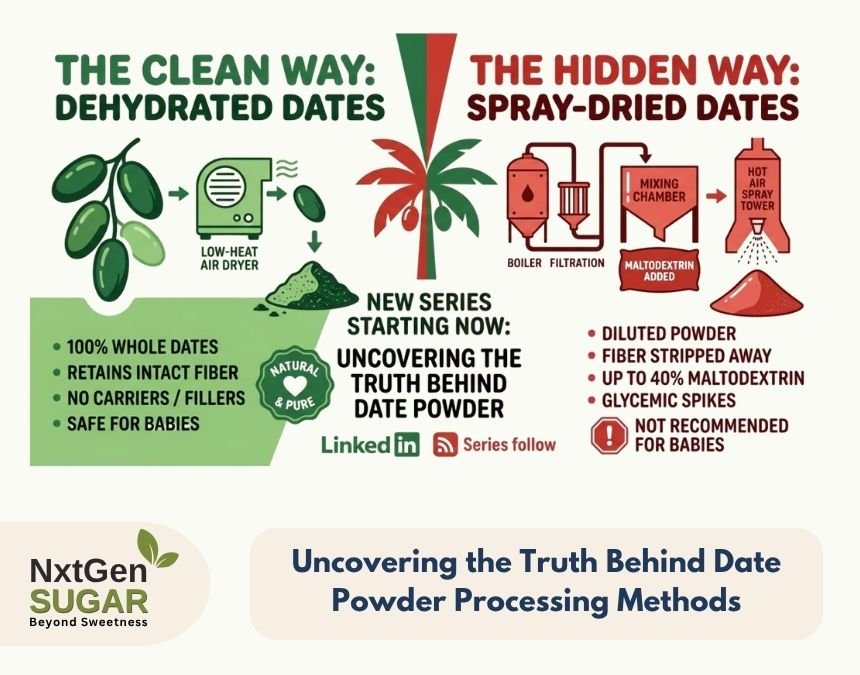
Is your “natural” sweetener really 100% dates? When evaluating dehydrated vs spray-dried date powder, most consumers do not realize that not all date powders are created equal. You might read “date powder” on the front of a label and assume you are getting pure, unadulterated fruit. The reality of industrial food processing is much more complicated.
Today, we are launching a new series to uncover the truth behind date powder processing, what actually goes into your food, and how to choose ingredients that are genuinely safe for your family and babies.

The fundamental divide in the natural sweetener market comes down to two vastly different manufacturing methods: pure mechanical dehydration versus industrial spray-drying. Understanding the battle of dehydrated vs spray-dried date powder is the only way to guarantee a clean-label product for your family.
While one method preserves the integrity of the whole fruit, the other relies on heavy chemical intervention, stripping away the very nutritional benefits that likely made you choose date powder in the first place.
When you want pure, whole-fruit nutrition, mechanical dehydration is the only acceptable processing method.
In this clean process, fresh, whole dates are gently processed through a low-heat air dryer. This minimal intervention simply removes the water weight while leaving the complete cellular structure of the fruit untouched.
The benefits of the dehydration method are undeniable:
-
100% Whole Dates: You receive exactly what is on the label – just dates.
-
Retains Intact Fiber: The natural soluble fiber matrix remains unbroken, which helps moderate digestion and blood sugar absorption.
-
No Carriers or Fillers: Zero chemical flowing agents or synthetic bulk are added to the final powder.
-
Safe for Babies: Because it is just pure fruit, it is a safe, whole-food introduction for infants and toddlers.
To cut costs and increase manufacturing speed, many commercial suppliers rely on a completely different process: spray drying.
In this method, the dates are boiled down and pushed through boiler filtration, creating a liquid syrup. This syrup is then pumped into a mixing chamber where it is heavily cut with a synthetic carrier powder—most commonly maltodextrin. This chemical slurry is then blasted through a hot air spray tower to instantly crystallize it into a fine powder.
This method destroys the integrity of the fruit:
-
Diluted Powder: You are paying for a product that is heavily watered down with cheap starch.
-
Fiber Stripped Away: The boiler filtration process completely removes the natural dietary fiber.
-
Up to 40% Maltodextrin: To force the liquid to dry into a powder, processors add up to 40% maltodextrin.
The biggest hidden danger in the dehydrated vs spray-dried date powder debate is the glycemic index. Maltodextrin is a highly processed carbohydrate that actually has a higher glycemic index than regular table sugar. Without fiber and heavily laced with maltodextrin, spray-dried powder causes rapid blood sugar spikes.
For a deep dive into how high-glycemic fillers like maltodextrin negatively affect metabolic health, you can review this comprehensive guide on carbohydrates and blood sugar by the Harvard T.H. Chan School of Public Health.
Due to the severe glycemic impact and synthetic additives, spray-dried date powder is not recommended for infant consumption. Babies and toddlers require nutrient-dense, whole foods without hidden chemical interventions.
At Sarika Ventures Pvt. Ltd. (SVPL), we believe transparency is the foundation of food safety. Our operational protocols ensure strict traceability from inward raw materials to final packaging, so you know exactly what is in your pantry.
Over the coming weeks, we will continue to break down exactly how to audit your food labels, spot hidden fillers, and ensure your natural sweeteners are actually natural.